Data Structures
Cafe extends the standard single-cell data model with two specialized structures: FateAnnData (the container) and MilestoneWrapper (the trajectory).
FateAnnData
FateAnnData extends AnnData and stores all Cafe metadata under uns["cafe"], so it remains compatible anywhere an AnnData is expected.
The cafe_dict Structure
fadata.uns["cafe"]  (cafe_dict)
├── id                              # Unique identifier
├── model_name                      # Currently active trajectory
├── prior_information               # Auto-detected: cluster, basis, start_cell
├── wrapper_type                    # Current wrapper type
└── trajectory_history_dict         # All trajectory results
    ├── "ref"                       # Reference trajectory
    │   ├── milestone_wrapper       # MilestoneWrapper object
    │   ├── waypoint_wrapper        # WaypointWrapper object
    │   ├── raw_wrapper_dict        # Raw method output
    │   ├── trajectory_embedding    # Cached embedding positions
    │   └── pseudotime_from_<...>   # Cached pseudotime
    ├── "scvelo"                    # scVelo trajectory
    └── ... (other methods)
Multi-Trajectory Storage
The trajectory_history_dict stores results from multiple method runs in a single FateAnnData object. This enables method comparison and benchmarking against a reference trajectory without duplicating the expression matrix.
Prior Information
Pior infomation is the key parameter for many plotting and method functions. Through automatic storage here, user rarely needs to specify them when calling these functions. -
cluster(Cafe auto-detects it fromobs.columns, checking"clusters","celltype") -basis(Cafe auto-detects it fromobsm.keys(), checking"X_umap","X_tsne","X_pca"), -start_cellshould be set manually.
Milestone Wrapper and Waypoint Wrapper
MilestoneNetwork models a trajectory as a graph: nodes (milestones) represent key cell states, edges represent transitions with direction and length.
WaypointWrapper densely samples the trajectory by placing evenly-spaced waypoints along edges. It not olny reduce computational complexity while visualizing.
Core DataFrames Instruction
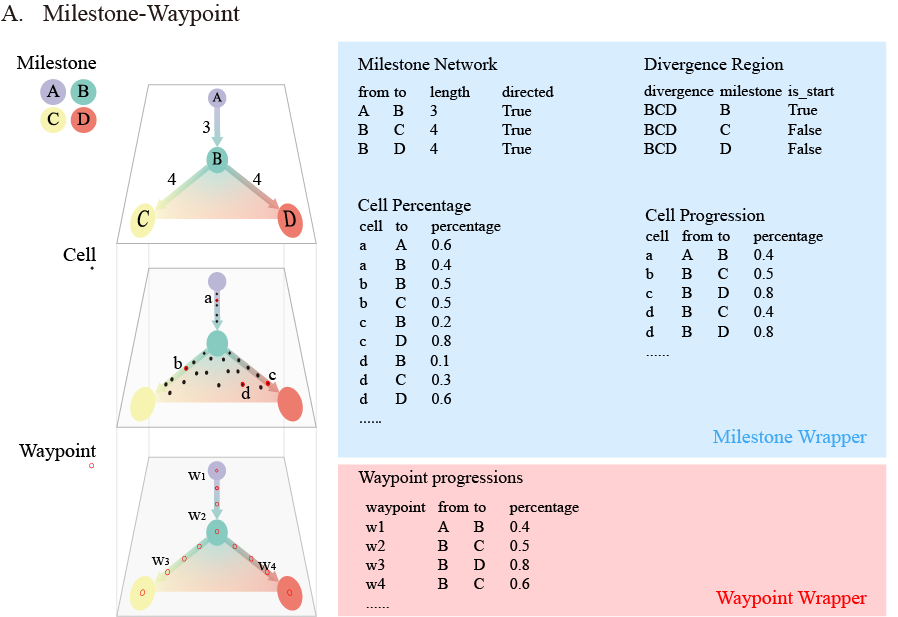
For Milestone Wrapper
| DataFrame | Purpose |
|---|---|
milestone_network |
Graph topology: from, to, length, directed |
progressions |
Per-cell edge assignment: which edge a cell is on and how far along (0–100%) |
milestone_percentages |
Per-cell milestone membership (proportions sum to 1). Convertible to/from progressions |
divergence_regions |
Annotated branch points: which milestones form each divergence region |
For Waypoint Wrapper
| DataFrame | Purpose |
|---|---|
waypoint progressions |
Per-waypoint edge assignment: which edge a cell is on and how far along (0–100%) |
Key Capabilities
- Subsetting by cells or edges, for zooming into trajectory regions
- Milestone renaming with automatic propagation across all DataFrames
- Edge-length adjustment by cell load for better visualization
- Merge operations for hierarchical refinement: replace a coarse milestone with a fine-grained sub-trajectory
- Color management: milestones auto-colored from cluster palettes; cell colors mixed from milestone colors weighted by membership